Today was the day. I had done my homework. I had written the blog post. I had prepped the talking points. I was ready to have “THE TALK“ The “AI Talk”… with my kids.
I called my kids over. I had done my research and I had examples and I was ready. This was one of those big parenting moments and I was going to CRUSH IT.
“So…” I said casually, trying to sound cool but not too cool, “have you guys ever heard of AI?”
Without missing a beat, my son shrugged and said, “Yeah. It’s like Siri and Alexa… Or Google.”
I blinked. Wait, what? How did he already know that?
“Where did you learn that?” I asked, genuinely curious. And maybe a tiny bit panicked, because hello? I had a whole moment planned!
He looked at me like it was the most obvious thing in the world. “I heard it on Kindly Keyin,” he said.
Oh. There it was. The proof of what I had just been writing about: If you don’t talk to your kids about important topics early, someone else will.
And today, that someone else was Kindly Keyin. (Kindly Keyin, if you’re reading this: no hard feelings. But next time, maybe give a mom a little heads up, okay?)
I laughed to myself, because of course this would happen. And honestly? It was the reminder I didn’t know I needed.
We think we’re ahead of the curve. We think we’ll be the first voice they hear. We plan the moment, the message, the memory.
But in today’s world, where a single YouTube video, a TikTok, a Roblox game can beat us to the punch… parenting isn’t about controlling every narrative. It’s about being available for the conversations when they come up.
It’s about staying in the room even after Kindly Keyin has said his piece. It’s about asking better questions and listening more than we lecture. It’s about being a safe place where our kids feel comfortable enough to say, “Hey, I heard this thing… what does it mean?”
And maybe most of all, It’s about not needing to have the “perfect” talk. It’s about having lots and lots of imperfect, messy, hilarious, random ones over time.
Today, I got beat out by Kindly Keyin. Tomorrow, it might be someone else. But every day, I’m still showing up. Every day, I’m still in the conversation.
Lately, I’ve been wondering, “Are my husband and I parenting our kids based on the world we grew up in… or the world they’re actually growing into?
It’s an uncomfortable question, because if I’m being honest, so much of what I default to (my instincts, my “rules,” my advice) was shaped by a childhood that looks nothing like the future my kids are heading toward.
For most of us when we grew up, “success” looked like: Get good grades. Go to college. Get a stable job. Get married. Buy a house. Have kids. Retire after 40 or so years.
But the rules have changed for our children. Many of the jobs that will exist when our kids graduate haven’t even been invented yet. Technology is evolving faster than we can comprehend.
Emotional intelligence, adaptability, and creativity are the real currencies of their future.
Are we preparing our kids for that? Or are we clinging to the lessons we needed in the past because they’re more comfortable for us now?
Maybe it’s human nature. We parent from experience because it’s what we know. It feels safe. It feels loving. It feels responsible. But what if, without meaning to, we’re accidentally preparing them for a world that doesn’t exist anymore?
I’m not writing this as an expert, by the way. I’m not sitting high on a mountain of “right answers.” I’m just a mom, standing in my kitchen, wondering if my advice is helping or holding them back.
Should I be pushing my kids to be the best at math… or teaching them how to think critically, creatively, and compassionately when faced with problems nobody’s solved yet?
Should I be rewarding perfect grades… or celebrating resilience, grit, and the courage to keep trying when things don’t come easily?
Should I be talking more about “safe” careers… or encouraging them to dream big, take risks, and define success in a way that feels meaningful to them?
It’s a lot to sit with. And maybe there’s no one-size-fits-all answer. Maybe the real answer is found by staying curious. If we parent with our eyes wide open instead of on autopilot perhaps we can help our kids build a future we can’t even imagine… but they can.
So tonight, as I tuck my kids into bed, I’ll ask myself again… Am I parenting based on my past? And am I brave enough to parent for their future?
I’d love to hear from you, have you ever thought about this too? What do you think our kids will really need from us to prepare for the future of work?
I think we can all agree that children learn best through stories, experiences, and conversations in safe, connected environments where they feel loved, seen, and supported. It’s through various forms of communication and experiences that kids grow into the brave, kind humans the world needs.
Today, parents have to talk about something they NEVER had to think about as kids and something most still don’t understand…
Artificial Intelligence.
It sounds big and complicated, but talking to kids about AI doesn’t have to be scary, confusing, or overwhelming. And the sooner we start to talk about it, the more confident and prepared our kids will be for the world they’re growing into.
You don’t need a computer science degree to talk to your kids about AI. But in today’s world parents have a new responsibility to understand the basics of it so that you can talk to you kids about it. Just like parents need to talk to kids about social media safety, tobacco safety, drug safety etc. – we have to talk about AI safety.
So how do we do it?
I did the research and here are my plans and suggestions for how parents can start these conversations at home today.
Start With What They Already Know
Our kids are already interacting with AI every day, even if you (and they) don’t realize it. Netflix recommends their shows. Alexa answers their questions. Even some toys have AI features built into them.
Here’s a start:
“You know how Netflix suggests shows you might like? That’s because of something called AI.”
AI is a Helper (a tool), Not a Boss
Kids need to learn about agency, the idea that they are in charge of their choices. Not their friends, or someone they chat with online, and certainly not AI.
When you talk about AI, you can say:
“AI is like a really smart tool. Like a calculator or google. It can help us find information or solve problems. But it doesn’t know right from wrong, it just follows instructions. It also doesn’t know everything and it doesn’t make decisions for us. People are always in charge.”
This teaches kids early on that technology is a tool and not a replacement for human thinking.
AI Can’t Feel (repeat that) – It’s not real
One of the biggest things kids need to know is that no matter how “smart” AI seems, it can’t feel emotions. You can’t hurt it’s feelings, it does not form real genuine connections.
So you could say:
“AI can tell you facts. But it can’t give hugs. It doesn’t have feelings like being happy, sad, excited, or scared. Only real people can do that.”
Keep the Conversation Two-Way
Kids are naturally curious, and when it comes to technology, that curiosity is gold.
To spark their curiosity (and yours) you could ask your kids questions like:
“What would you build if you could create your own AI tool?”
“What do you think a robot would be good at?”
“What do you think a robot would not be so good at?”
These conversations build understanding, critical thinking and creativity.
“AI is smart at information, but people are smart at feelings, kindness, and creativity.”
Start small, stay open, and stay curious. Remind your kids that real human connection, curiosity, and creativity can never be programmed or replaced.
That’s the heart of what we want kids to know. That’s what will never be replaced by technology.
If You’re Trying to Get People to Take You Seriously, I have the book for you.
You can be the smartest person in the room, have the best idea, and work harder than everyone else but if people don’t like you, or if they don’t listen to you, you’re going to end up spinning your wheels.
There is a book that was written nearly 90 years ago that is still relevant today. The book is, How to Win Friends and Influence People written by Dale Carnegie.
If you are: :
A mom returning to the workforce
Someone who wants to rebuild their confidence (and influence)
A creator, writer, or small business owner
An introvert who wants to connect more easily without feeling fake
Anyone who struggles with networking or “selling themselves”
Then you should read this book.
Most of us were never taught how to actually build strong relationships. We were told to “be nice,” “work hard,” or “just be yourself.” In this book, Carnegie breaks it down in a way that’s practical, timeless, and surprisingly kind.
This book taught me:
How to talk so people want to listen (without being manipulative).
How to make people feel seen and valued.
Why it’s often better to listen more and talk less and in a way that builds connection.
That kindness and curiosity can open doors faster than expertise.
If you’ve ever walked away from a conversation thinking, “Why didn’t I say that differently?” Or if you’ve felt invisible in a meeting… or awkward talking to new people… this is a great read.
It’s not about being fake. It’s about being intentional. It’s about being interested, not just interesting.
Here’s something I’ve been realizing lately in my own home:
Sometimes it’s not that my kids don’t hear me, it’s that they don’t want to do what comes next.
And honestly? That makes sense.
Sometimes they’re:
Deep in imaginative play
Zoned out with their favorite show
Totally immersed in the iPad
Avoiding what’s next (like brushing teeth… because bedtime = the end of fun)
I get it. I don’t love being interrupted either. And I definitely don’t love doing things I don’t want to do.
But when I assume they’re “not listening,” I think I miss the real reason they’re resisting…
… They’re not ready to let go of the moment they’re in.
What I’m Trying Instead
1. Acknowledge What They’re Doing First
Before jumping into a command or correction, I’m learning to start with connection.
“You’re really focused on that show, looks like you’re loving it.” “I see you’re right in the middle of that game, it’s hard to pause when you’re having fun.”
That simple acknowledgment often diffuses the resistance.
2. Prep for the Shift
This is huge. Instead of surprising them with a demand, I’m trying to give a soft landing into what comes next. Which also requires me to stay on task and on time so I can give them notice when it’s realistically possible.
“We’re brushing teeth in five minutes. Want to brush now or finish this level and then pause?” “You don’t have to stop right this second, but you do need to be ready in five minutes. Do you want to be in charge of the timer or would you lime me to?”
Timers, transitions, and reminders help all of us stay on task and make the shift feel less abrupt.
3. Validate the Feeling (Even If the Boundary Stays the Same)
Sometimes my kids don’t want to stop what they are doing because what’s next feels like a loss. And that’s valid.
“I know, it’s hard to end something you’re enjoying. I feel that way too when my favorite part of the day is over. You’re allowed to be upset. And it’s still time to get ready. Would you like to walk backwards or crab walk to the room to get changed?”
This isn’t permissive parenting. It’s connected parenting. The boundary stays the same, but the relationship stays intact.
What I’m Learning…
When I stop assuming “they’re not listening” and start asking, “What are they holding onto? What are they avoiding?” everything softens.
It doesn’t mean I always get cheerful cooperation. But it does mean fewer power struggles, more empathy, and better transitions.
And like everything in parenting, I’m still learning. Still practicing. Still growing.
One moment. One pause. One small shift at a time.
Have you noticed this with your kids, too? What helps you support them through transitions when they’re deep in their own world?
Thanks for sticking through this with me, it means more than you know.
Well… that was fast. I failed at my own challenge in less than 24 hours. How quickly I forgot my commitments. It’s embarrassing, but it’s honest. However, after failing miserably I caught myself and reminded myself of the commitment I made… for all the world to see. So I started over.
But first, here’s why I think I failed. I was in the middle of dishes at the end of the night and hollered at the kids to clean up their things from the living room. Which they started to and then got distracted because, well they’re kids. So then I hollered again, still from the kitchen sink, and they started again… and then got distracted again. So then I shouted (aka yelled) at them to get back to the living room to clean NOW! So they hurried in and started cleaning again.
Then I looked at my husband and said, well that didn’t work. He was well aware of the commitment I had made and we were both well aware that neither of us had done either of my three commitments.
So in that moment, I stopped and started over.
Eliminate distractions… so I turned off the sink and walked over to my kids. Connect… I clearly and respectfully told them to look at me so I could see their cute little eyes. Why would they want to listen… I reminded them that it was our plan to go to visit family the next day and waking up to a clean house meant we could leave that much sooner. OR we could go to bed now and leave later the next day. It wasn’t a threat, it was the truth with compassion. I knew how excited they were to visit their family and friends, and I knew they would want to leave sooner rather than later. Win win!
And what do you know, THEY LISTENED!
I got down on their level. I said their names with warmth. I gave a choice. I stayed calm.
And it worked. Bam.
Since then, I’ve continued to research why this works and here’s what I’ve discovered:
Listening Isn’t Always Instant
Kids are not mini-adults. They’re still developing the skills we expect from them. That includes things like emotional regulation, impulse control, and yes… listening.
One idea that really stood out to me came from Dr. Becky Kennedy, the clinical psychologist behind Good Inside. She often reminds parents that:
“Your child isn’t giving you a hard time, they’re having a hard time.”
This statement reframed something for me.
What if, when my kids don’t listen, it’s not defiance… it’s dysregulation? What if they’re not ignoring me… they’re overwhelmed? Or overstimulated? Or can’t articulate how hard transitions are?
I learned from The Whole-Brain Child by Dr. Dan Siegel and Tina Payne Bryson that kids literally can’t access the logical “listening” part of their brain when they’re in a state of emotional overload. For my neurodivergent child, transitions are super hard and can sometimes be emotionally overwhelming.
“When we expect children to listen when they’re emotionally overwhelmed, we’re expecting them to access a part of the brain that’s not online yet.”
Okay. That made sense. So now I’m asking…
What Can I Do Instead?
Here are a few things I’m experimenting with now, because I want to get better at this too.
1. Pause and Check the Environment
Sometimes my child can’t listen because something else is in the way.
Are they hungry? Tired? Overstimulated?
Are they deep in play?
Is their brain still processing a big feeling?
If the answer to any of those is yes, maybe they can’t listen yet… not because they won’t, but because their system is maxed out.
I’d like to try this instead:
“Looks like your brain is still busy. Let’s take a break and I’ll check back in.”
2. Reconnect Before I Repeat
Dr. Becky often says, “Connection before correction.”
Now, I’m trying to go to my kids, not shout at them from the kitchen. I might kneel down, put a hand on their shoulder, and say their name softly before I speak.
What I try saying:
“You were so focused on that game, I get it. I need your attention now and we can refocus on that in just a moment (or at an honest time)”
It may not always work perfectly, but it works better than barking commands from across the house.
3. Accept That Listening is a Long Game
I used to think: “I explained it calmly. Why didn’t they just do it?”
Now I’m learning to expect a learning curve. Like brushing their teeth or tying shoes, listening is a skill that takes years (not days) to develop.
A reminder for myself:
“I’m planting seeds. It may not show up right now, but it’s growing.”
4. Natural Consequences (Not Threats)
I’m still learning how to handle this part, but something that helps is thinking about natural consequences instead of punishments.
For example:
“If we don’t leave now, we won’t have time for the park.”
“If these toys aren’t cleaned up, they’ll take a rest on the shelf for the day.”
It’s not about getting revenge. It’s about letting real life do the teaching, not threats or shame.
(More on consequences in the next post, because I still have a lot of questions there too.)
5. Reset When I Mess Up
This one is big for me.
Sometimes, even after all my efforts, I get frustrated. I snap. I raise my voice. I go into lecture mode.
And then I feel awful.
But what I’m learning is: it’s never too late to reconnect.
What I’d like to try saying:
“I didn’t like how I spoke to you earlier. Let’s try again. I want to be calm, even when it’s hard.”
Final Thoughts
I don’t have it all figured out. I’m still learning. Still trying. Still asking new questions every day.
But I do believe this:
Listening is a skill. And parenting is a relationship, not a performance.
So if your child still isn’t listening, even after all your gentle tools, it doesn’t mean you’re failing.
It just means, like me and your kids, we’re all still learning.
As parents, one of the most frustrating things is feeling like a broken record.
“Put on your shoes.” “Brush your teeth.” “Please clean that up.” “Did you hear me?”
And yet… nothing. Or we say it again. Or worse… large sighs, resistance, or meltdowns.
I often wonder, “Why don’t my kids listen the first time?” But this week I thought to myself, maybe I’m asking the wrong question…
The better question might be: “How do I help my child care enough to want to listen?”
Side note: I read this blog to my 9 year old son and he wanted me to add in this as an example…
“For example, my son will only listen to me when he gets rewarded with Youtube or iPAD.”
This may sound like bribing, but let’s talk about why this actually works.
You may not know this about me, but I’m basically a professional researcher. Once I question something, or get deeply curious, I’m like a dog with a bone. I will listen to every podcast, YouTube, Instagram Reel, or Tik Tok that I can find. I’ll go down every Reddit rabbit hole and listen to as many audiobooks on the topic that I can.
Interestingly enough, as part of my Masters Program I recently read the book, How to Win Friends and Influence People, by Dale Carnegie. If you haven’t read this it’s a classic that I recommend for anyone seeking to improve their interpersonal skills, build stronger relationships, and navigate social interactions more effectively, both professionally and personally.
One of the most powerful lessons from How to Win Friends and Influence People is this:
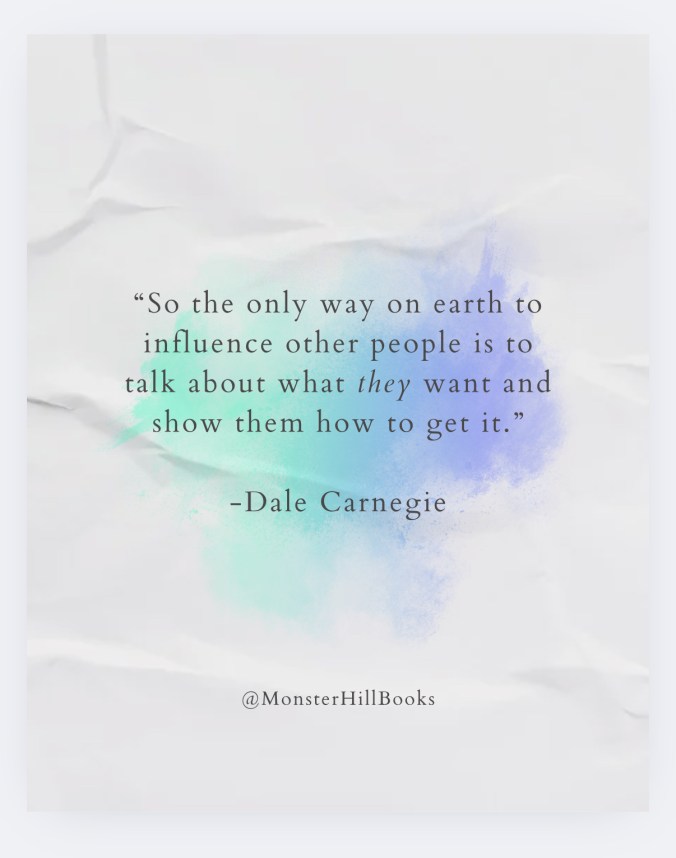
“The only way to influence people is to talk in terms of what the other person wants.”
So I figured the principles in this book could be applied to parenting.
Here’s what I mean. Instead of saying, “Because I said so,” could we frame this request in terms of what the child actually wants or cares about.
For example:
Instead of: “Brush your teeth now!” Try: “Let’s brush now so we have time for two bedtime stories!” Or in my sons case, “Do your best to clean this up in under 10 minutes so you can earn 10 points towards iPAD minutes for the weekend”.
And then, if they do this and they actually listen, Carnegie teaches us to give honest and sincere appreciation. This seems like a given, but praise never gets old.
For example:
“Thank you for coming the first time I asked, that really helped us get out the door on time.”
If we want our children to care, we have to show them how much we care… about them.
When kids feel disconnected or unseen, they’re less likely to respond. It’s not because they’re bad or broken, it’s because cooperation starts with relationship.
Carnegie teaches us that listening isn’t just about obedience. It’s about engagement. And engagement comes from emotional safety, mutual respect, and a sense of belonging. The way to win people over is by seeing them, valuing them, and talking in terms of what they care about. And it turns out, this applies beautifully to raising emotionally intelligent kids. If we want kids to listen, we must first understand why they would want to. We can’t demand cooperation, we have to invite it, by appealing to what matters to them.
Connecting actions to desires is a powerful motivator for adults, so why wouldn’t it work for kids? My son cares deeply about the iPAD but it’s something we limit at great lengths in our family. Is this something I can leverage to get him to do what I want, or is that just a fancy way of bribing my child…? What do you think?
I’m putting myself on a 14-day challenge.
How It Works:
For 14 days, I will repeat the same 3 commitments (listed below) inspired by Dale Carnige’s principles.
My hope is that by completing this challenge I can shift the energy in my home without yelling, nagging, or power struggles.
Try it with me!
I have to remind myself this isn’t about perfection. I will do my best to model my own emotional regulation, grounded leadership, and genuine respect for my children’s experience. When I type it all out it seems so obvious, so why isn’t it? Well perhaps that’s a blog for another day.
My Three Commitments
✅ 1. Connect Before I Correct
Before making any requests, I commit to getting down on their level, saying their name, and getting their attention by touching their shoulder and/or making eye contact. I also commit to decreasing distractions like turning off the TV, or pausing what I’m doing… (cough cough) get off the dang cell phone.
✅ 2. I Will Make One Clear, Choice-Based Request
I will limit the ask to one clear instruction and offer a sense of autonomy:
💡 “Let the other person feel the idea is theirs.” – Dale Carnegie
“Would you like to clean up the books or the blocks first?”
“Do you want to walk or crab-crawl to the bathroom?”
✅ 3. Praise the Effort, Not the Outcome
I will end with sincere encouragement:
“You listened the first time, thank you for that.”
“I saw how hard you tried even though it was tough. That was awesome.”
Checklist Summary
Each day, I will repeat the same three actions: ☑️ Connect before making a request ☑️ Give one clear, choice-based request ☑️ Praise effort or identity
In two weeks I’ll come back and reflect on my findings of what improved, what stayed the same, or what surprised me.
Final Thoughts
I’ve learned that my children aren’t ignoring me to test my limits. They’re learning how to listen, how to cooperate, and how to regulate big feelings in a noisy world. And it’s my job to guide them along the way.
So let’s do it together.
One moment. One conversation. One “yes, Momma” at a time.
We’ve got this. 💛
I appreciate you taking the time to read my blog more than you know.
Can we talk about that sneaky little voice that pops up when I’m doing something new, exciting, or a little scary. You have that too, right? You know the one:
“Who do you think you are?” “You’re not ready for this.” “You’re going to mess it all up.”
I cringe at talking about “imposter syndrome” because it seems like such a buzz word, but it’s so real and it’s more common than most of us realize. Even the most confident, successful people deal with it — I’ll explain more in just a minute.
Here’s something I’ve learned about imposter syndrome: it isn’t a sign that you’re not good enough. It doesn’t mean you aren’t qualified. And it doesn’t mean you can’t. It’s actually a sign that you’re stepping into something important. It usually shows up when you’re stretching into a new version of yourself and doing something meaningful… something real.
You may not feel like you’re qualified. You might even think you’re faking it. But the truth is, you’re probably just growing. That awkward, uncomfortable feeling of not quite fitting into your new shoes? That’s transformation in real time.
When I first started writing, I wasn’t sure what I was doing. Honestly, I still don’t. I don’t have a fancy degree in children’s literature or a bookshelf full of published work. But I enjoy it and I have have a message I believe in and that matters to me. That voice in my head still tells me I’m not qualified. It told me to wait. It told me someone else would do it better. But I kept writing and hired a coach to drown out the doubt.
Imposter syndrome isn’t logical. It feels real and convincing, but it doesn’t actually reflect the truth of who you are or what you’re capable of. It ignores your wins, your heart, your intention. It tries to protect you by keeping you small… but who wants that?
If you’re waiting to feel confident before you begin, let me save you some time: confidence comes after you start. You build it by showing up, even when you’re unsure. You grow it by doing the thing messy, unpolished, and imperfect. Action creates confidence, not the other way around.
And if you think you’re the only one who has ever doubted themselves, think again.
Sylvester Stallone was rejected by over 1,500 talent agents. He was broke, homeless, and struggling to eat. But he refused to sell the Rocky script unless he could star in it. People told him he wasn’t good enough, that he had no experience. He did it anyway. And he made history.
J.K. Rowling was a single mom living on welfare when she wrote Harry Potter. Twelve publishers said no. She kept going.
Walt Disney was told he lacked imagination. Oprah Winfrey was told she was unfit for TV. These are not small names. These are people who were doubted, dismissed, and still chose to believe in their vision.
If you’re reading this and sitting on a dream, waiting to feel “ready” or “more qualified,” this is your permission to go for it. You don’t have to be perfect. You just have to be willing.
You are allowed to want something more. You are allowed to step into something that lights you up even if it doesn’t make total sense to anyone else yet. Especially if it scares you a little. As long as it aligns with your values and feels right in your heart – go for it!
That fear you feel? That’s not proof you’re a fraud. It’s proof you’re on the edge of something meaningful.
So here’s my advice: take the step. Write the story. Apply for the job. Launch the business. Go back to school. Try the thing your heart keeps whispering about.
Not because you’re certain. But because you’re called.
Imposter syndrome doesn’t mean you’re not ready. It means you’re brave enough to grow.
And that, my friend, is exactly where the magic happens.
There are many paths to becoming a published author today. Self-publishing has created space for countless voices to be heard, and there’s no shortage of inspiring stories about authors who took matters into their own hands and found massive success. In fact, I believe Mel Robbins originally self-published before her work became a global phenomenon. So why did I choose to pursue traditional publishing instead?
The short answer? Time, support, and strategy.
I’m a mom. A wife. A full-time corporate leader. And I’m halfway through my master’s degree program. Time is not something I have in excess right now, and everything I’ve learned about self-publishing tells me that it requires a lot of time and energy—not just to write the book, but to market it, design it, distribute it, and manage every detail. That’s not something I can take lightly.
I’m also a researcher at heart. When I decide to pursue something, I go all in. So I’ve listened to every podcast, watched hours of YouTube videos, and dug into article after article comparing self-publishing to traditional publishing. I’ve learned from people who have done both. I’ve heard success stories and horror stories from each side.
In the end, I chose traditional publishing because I want the guidance and the backing of a team that knows the industry inside and out. I want to learn from professionals who have walked this road before and who believe in my work enough to help bring it to life. I want the marketing support, the editorial expertise, and the momentum that comes from being part of something bigger.
That’s also why I hired a coach. I want to take this seriously. I want to be taken seriously. And I believe that investing in the right help now will pay off in the long run. I’m currently working with my coach to finalize my very first story and prepare to query literary agents. It’s a process, but it’s one I’m committed to.
Traditional publishing may take longer, but for me, it feels aligned with my long-term vision. I don’t want to rush it. I want to do it right. I want to build something meaningful and lasting…
And I’m so excited to take you with me on this journey.
From the bottom of my heart, thank you for being here.
You might be wondering why I started an Instagram page for Monster Hill Books considering I don’t have a single book available for purchase… It’s a fair question, and the answer is simple: I didn’t want to quit.
I’ve written six children’s stories that I’m incredibly proud of. They live on my laptop, but they’re also alive in my heart. And I knew that if I kept them hidden, safely tucked away, they would stay there forever.
Starting an Instagram page was my way of saying, “I’m doing this, I’m going for it.” It was my way of creating accountability, momentum, and overcoming fear. When you publicly declare a dream—even in its earliest stage—it’s a powerful motivator to keep going.
That’s also why I hired an author coach. I don’t know what I’m doing. I don’t know how to become a professional author. I don’t know how to navigate the publishing world. But I do know how to take a dream seriously. And for me, that meant investing in someone who could guide me through this process and keep me on track. Having the accountability of a coach has made all the difference.
Right now, I’m working with my coach to finalize the first story I ever wrote. It’s the story that started it all, and it’s the one I hope will be the first to get traditionally published. While it’s still unpublished, it’s very much in progress—and sharing that journey on Instagram helps me stay connected, inspired, and encouraged. And hopefully, I can motivate a few others to go after their dream as well.
So no, I don’t have a book to sell (yet). But I have a vision. I have stories. I have purpose. And I believe that showing up, even before the dream is fully realized, is part of what makes it real.
Know this: you don’t have to have it all figured out before you begin. Sometimes, the act of starting is what keeps the dream alive.







 Welcome to Monster Hill