Lately, I’ve been wondering, “Are my husband and I parenting our kids based on the world we grew up in… or the world they’re actually growing into?
It’s an uncomfortable question, because if I’m being honest, so much of what I default to (my instincts, my “rules,” my advice) was shaped by a childhood that looks nothing like the future my kids are heading toward.
For most of us when we grew up, “success” looked like: Get good grades. Go to college. Get a stable job. Get married. Buy a house. Have kids. Retire after 40 or so years.
But the rules have changed for our children. Many of the jobs that will exist when our kids graduate haven’t even been invented yet. Technology is evolving faster than we can comprehend.
Emotional intelligence, adaptability, and creativity are the real currencies of their future.
Are we preparing our kids for that? Or are we clinging to the lessons we needed in the past because they’re more comfortable for us now?
Maybe it’s human nature. We parent from experience because it’s what we know. It feels safe. It feels loving. It feels responsible. But what if, without meaning to, we’re accidentally preparing them for a world that doesn’t exist anymore?
I’m not writing this as an expert, by the way. I’m not sitting high on a mountain of “right answers.” I’m just a mom, standing in my kitchen, wondering if my advice is helping or holding them back.
Should I be pushing my kids to be the best at math… or teaching them how to think critically, creatively, and compassionately when faced with problems nobody’s solved yet?
Should I be rewarding perfect grades… or celebrating resilience, grit, and the courage to keep trying when things don’t come easily?
Should I be talking more about “safe” careers… or encouraging them to dream big, take risks, and define success in a way that feels meaningful to them?
It’s a lot to sit with. And maybe there’s no one-size-fits-all answer. Maybe the real answer is found by staying curious. If we parent with our eyes wide open instead of on autopilot perhaps we can help our kids build a future we can’t even imagine… but they can.
So tonight, as I tuck my kids into bed, I’ll ask myself again… Am I parenting based on my past? And am I brave enough to parent for their future?
I’d love to hear from you, have you ever thought about this too? What do you think our kids will really need from us to prepare for the future of work?
As parents, one of the most frustrating things is feeling like a broken record.
“Put on your shoes.” “Brush your teeth.” “Please clean that up.” “Did you hear me?”
And yet… nothing. Or we say it again. Or worse… large sighs, resistance, or meltdowns.
I often wonder, “Why don’t my kids listen the first time?” But this week I thought to myself, maybe I’m asking the wrong question…
The better question might be: “How do I help my child care enough to want to listen?”
Side note: I read this blog to my 9 year old son and he wanted me to add in this as an example…
“For example, my son will only listen to me when he gets rewarded with Youtube or iPAD.”
This may sound like bribing, but let’s talk about why this actually works.
You may not know this about me, but I’m basically a professional researcher. Once I question something, or get deeply curious, I’m like a dog with a bone. I will listen to every podcast, YouTube, Instagram Reel, or Tik Tok that I can find. I’ll go down every Reddit rabbit hole and listen to as many audiobooks on the topic that I can.
Interestingly enough, as part of my Masters Program I recently read the book, How to Win Friends and Influence People, by Dale Carnegie. If you haven’t read this it’s a classic that I recommend for anyone seeking to improve their interpersonal skills, build stronger relationships, and navigate social interactions more effectively, both professionally and personally.
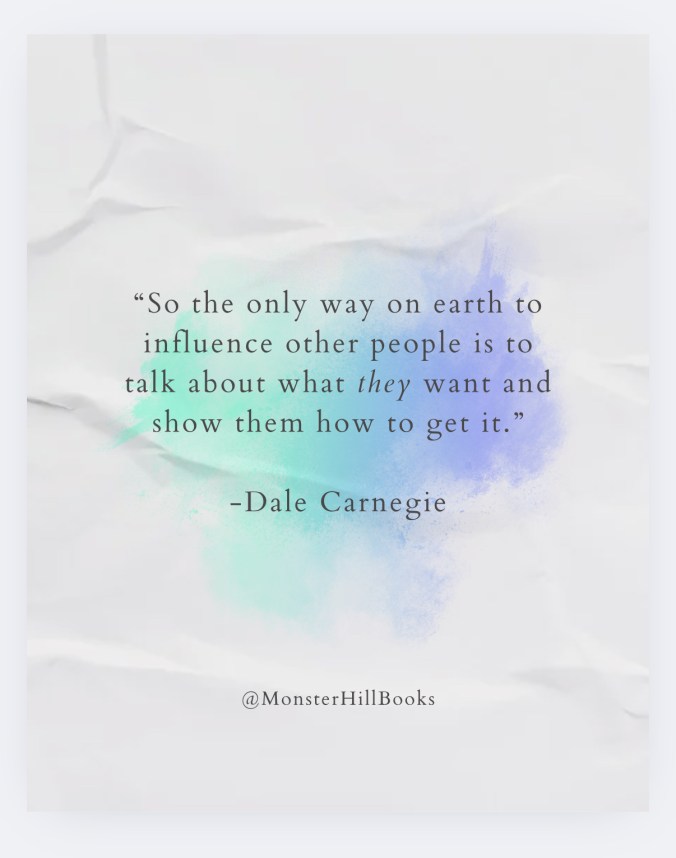
One of the most powerful lessons from How to Win Friends and Influence People is this:
“The only way to influence people is to talk in terms of what the other person wants.”
So I figured the principles in this book could be applied to parenting.
Here’s what I mean. Instead of saying, “Because I said so,” could we frame this request in terms of what the child actually wants or cares about.
For example:
Instead of: “Brush your teeth now!” Try: “Let’s brush now so we have time for two bedtime stories!” Or in my sons case, “Do your best to clean this up in under 10 minutes so you can earn 10 points towards iPAD minutes for the weekend”.
And then, if they do this and they actually listen, Carnegie teaches us to give honest and sincere appreciation. This seems like a given, but praise never gets old.
For example:
“Thank you for coming the first time I asked, that really helped us get out the door on time.”
If we want our children to care, we have to show them how much we care… about them.
When kids feel disconnected or unseen, they’re less likely to respond. It’s not because they’re bad or broken, it’s because cooperation starts with relationship.
Carnegie teaches us that listening isn’t just about obedience. It’s about engagement. And engagement comes from emotional safety, mutual respect, and a sense of belonging. The way to win people over is by seeing them, valuing them, and talking in terms of what they care about. And it turns out, this applies beautifully to raising emotionally intelligent kids. If we want kids to listen, we must first understand why they would want to. We can’t demand cooperation, we have to invite it, by appealing to what matters to them.
Connecting actions to desires is a powerful motivator for adults, so why wouldn’t it work for kids? My son cares deeply about the iPAD but it’s something we limit at great lengths in our family. Is this something I can leverage to get him to do what I want, or is that just a fancy way of bribing my child…? What do you think?
I’m putting myself on a 14-day challenge.
How It Works:
For 14 days, I will repeat the same 3 commitments (listed below) inspired by Dale Carnige’s principles.
My hope is that by completing this challenge I can shift the energy in my home without yelling, nagging, or power struggles.
Try it with me!
I have to remind myself this isn’t about perfection. I will do my best to model my own emotional regulation, grounded leadership, and genuine respect for my children’s experience. When I type it all out it seems so obvious, so why isn’t it? Well perhaps that’s a blog for another day.
My Three Commitments
✅ 1. Connect Before I Correct
Before making any requests, I commit to getting down on their level, saying their name, and getting their attention by touching their shoulder and/or making eye contact. I also commit to decreasing distractions like turning off the TV, or pausing what I’m doing… (cough cough) get off the dang cell phone.
✅ 2. I Will Make One Clear, Choice-Based Request
I will limit the ask to one clear instruction and offer a sense of autonomy:
💡 “Let the other person feel the idea is theirs.” – Dale Carnegie
“Would you like to clean up the books or the blocks first?”
“Do you want to walk or crab-crawl to the bathroom?”
✅ 3. Praise the Effort, Not the Outcome
I will end with sincere encouragement:
“You listened the first time, thank you for that.”
“I saw how hard you tried even though it was tough. That was awesome.”
Checklist Summary
Each day, I will repeat the same three actions: ☑️ Connect before making a request ☑️ Give one clear, choice-based request ☑️ Praise effort or identity
In two weeks I’ll come back and reflect on my findings of what improved, what stayed the same, or what surprised me.
Final Thoughts
I’ve learned that my children aren’t ignoring me to test my limits. They’re learning how to listen, how to cooperate, and how to regulate big feelings in a noisy world. And it’s my job to guide them along the way.
So let’s do it together.
One moment. One conversation. One “yes, Momma” at a time.
We’ve got this. 💛
I appreciate you taking the time to read my blog more than you know.

 Welcome to Monster Hill